

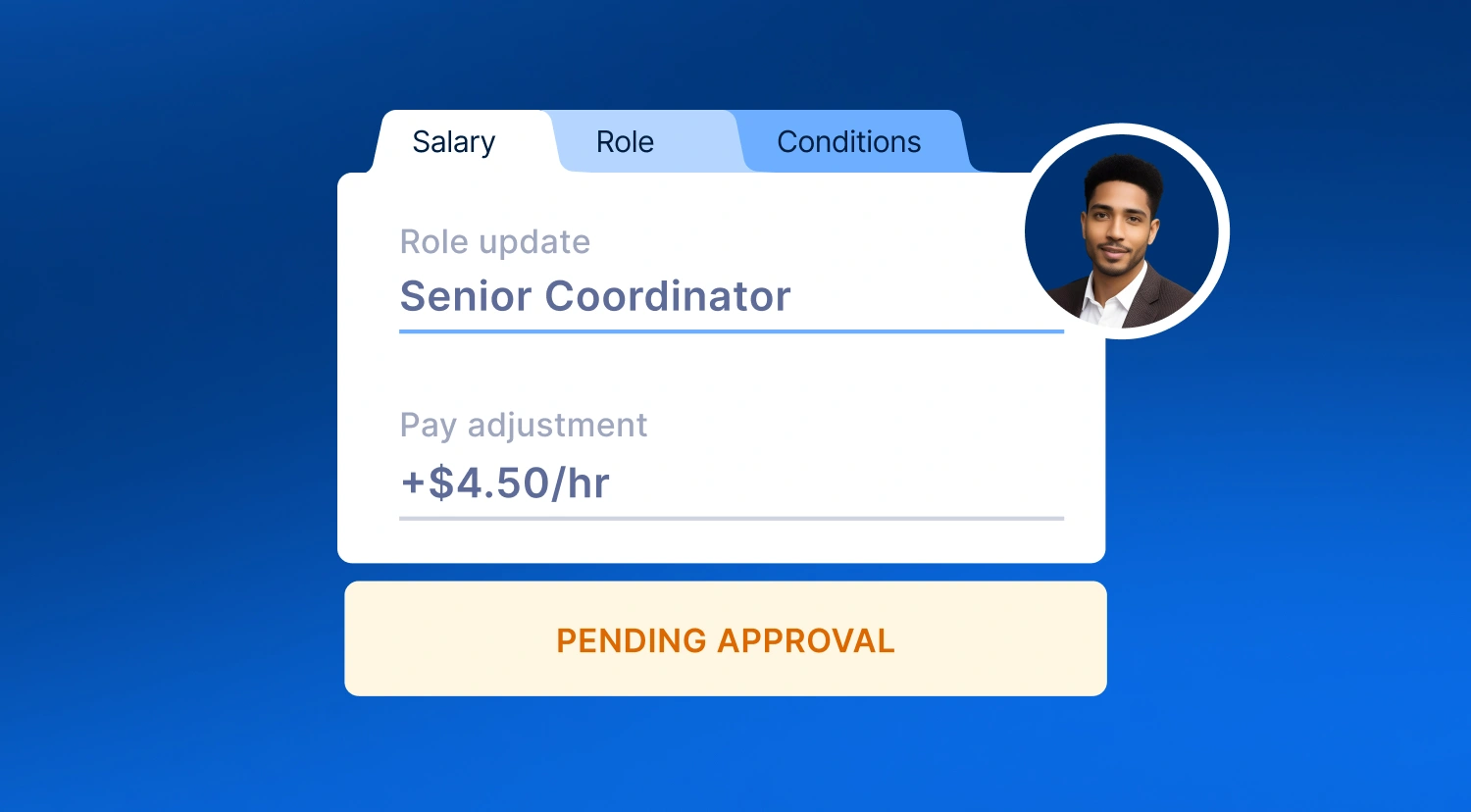
Business needs change over time, and employers regularly ask whether they can adjust a sponsored worker's duties, salary, or hours.
In many cases, the answer is yes – but that flexibility has limits, and a change that looks routine from an HR perspective can quietly put you out of step with your sponsor obligations. The safest approach is to understand where the boundaries sit before the change takes effect (rather than after).
Here's what employers need to know.
The starting point
To comply with their sponsor obligations, employers must ensure that a worker sponsored on a Subclass 482 (Skills in Demand) visa continues to work in their nominated occupation, and earns no less than their nominated full-time salary.
These two points sit behind almost everything that follows. The nominated occupation and salary are the basis on which the visa was granted, so the role the worker actually performs – and what they are paid to perform it – need to remain consistent with that nomination.
Changing duties or position title
A degree of change is entirely normal, and a change in position title or duties does not necessarily mean the worker has changed occupation. The important point is that the worker continues to perform duties consistent with the occupation for which their Subclass 482 visa was granted.
Some changes to a sponsored worker's role must be notified to the Department of Home Affairs within a set timeframe, though not every change triggers a notification. It's worth confirming whether a particular change is notifiable – and by when – before it takes effect.
If the change is substantial enough that the role can be seen to fall within a different occupation, the position should be assessed before the change takes effect. A new nomination – and potentially a new visa application – may well be required.
Our team at Xemplo Legal can help assess the proposed change and advise on what needs to happen before it's implemented.
Can you change a sponsored worker’s salary?
The nominated salary operates as a floor.
Generally speaking, it's fine for a worker's salary to increase from the nominated amount – whether through a pay rise, a market adjustment, or similar – and no notification is required in that case.
The salary should not, however, decrease below the nominated amount. In some limited situations, it's possible for a worker to move to a part-time arrangement, with their salary reduced on a pro-rata basis. Whether that's available depends on the specific circumstances, so please contact us so we can advise on such an arrangement.
Short of a genuine part-time arrangement, where the intent is to reduce a sponsored worker's salary, a new 482 nomination will be required. Importantly, the salary can only be reduced once that new nomination has been approved – you cannot reduce the salary first and regularise it afterwards.
There are also only limited circumstances in which a new nomination with a reduced salary will be accepted, so a reduction should not be assumed as a straightforward option.
RELATED: What Happens When A Sponsored Employee Resigns Or Is Terminated?
Sponsored workers must receive no less favourable employment conditions
Finally, it's important to note that the conditions of employment must not only match what was stated in the approved nomination – they must also be no less favourable than those that apply to an equivalent Australian worker employed with the company.
This principle extends beyond salary to the wider package, such as working hours, leave, and other entitlements.
For example: you could not ask a sponsored worker to work 60 hours per week where the equivalent Australian employee works 40. The practical test is to benchmark the sponsored worker's arrangement against a comparable Australian colleague and make sure they are not being treated less favourably.
Before you make a change
If you're considering a change to a sponsored worker’s role, salary, or employment conditions, it's worth confirming the position before the change takes effect. It's far easier to structure a change correctly at the outset than to try to unwind one later.
Please reach out to Xemplo Legal before making the change (we'd be more than happy to assist).
This article provides general information only and does not constitute legal advice. It does not take into account your specific circumstances and should not be relied on as a substitute for advice tailored to your situation. For advice about your particular circumstances, please contact Xemplo Legal.

_%20A%20Guide%20for%20Australian%20Employers.webp)

.webp)