
Hiring someone entails much more than finding the “right fit.”
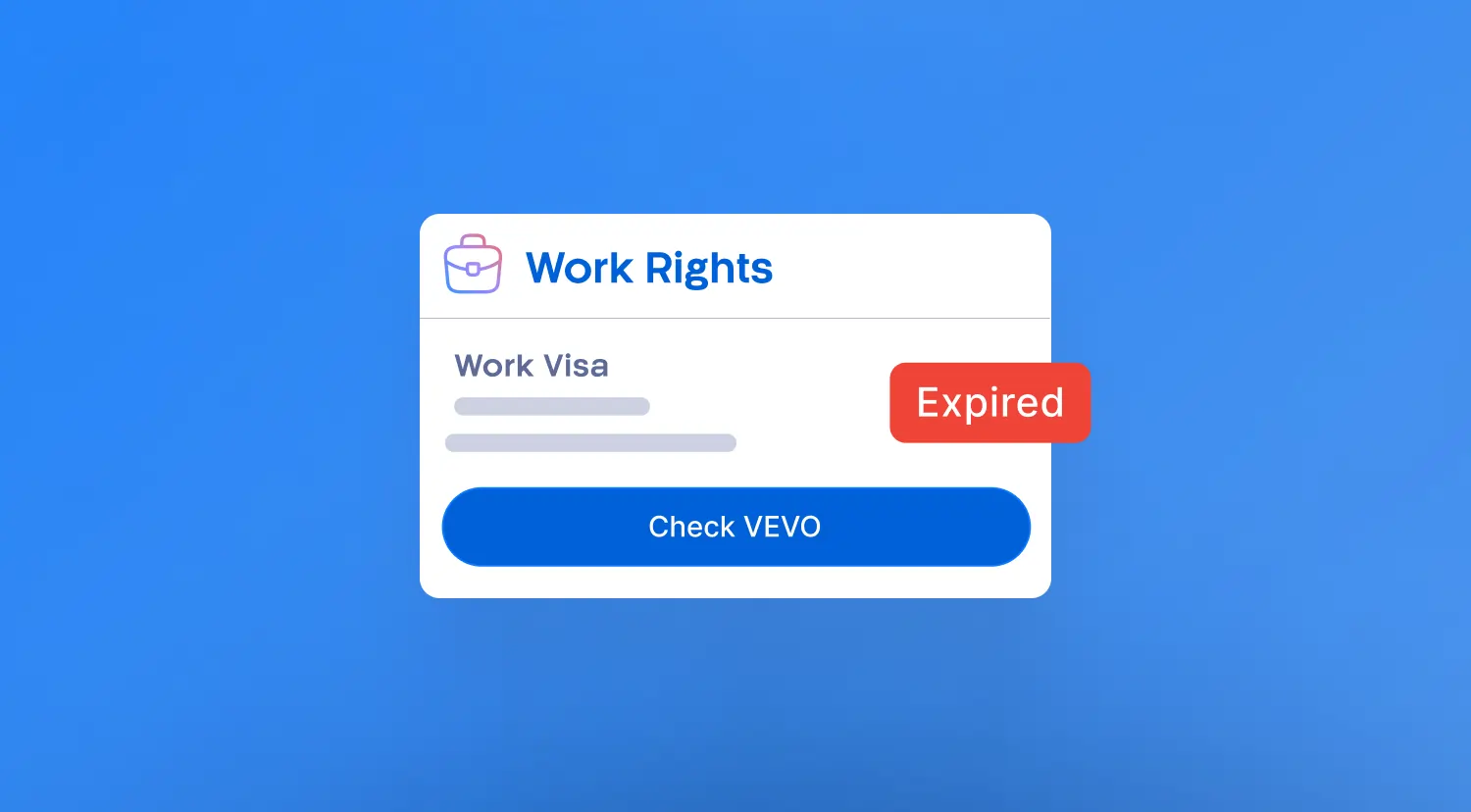
Before a worker can start, businesses need to confirm that their new hire is legally permitted to work in Australia – which, in theory, sounds simple enough. But Visa Entitlement Verification Online (VEVO) and work rights checks tend to become a compliance task that can get very messy, very quickly.
A passport scan lands in someone’s inbox. HR logs into the Department of Home Affairs VEVO portal. Details are typed in manually. A PDF is downloaded and saved somewhere. Someone else updates a spreadsheet. Fast forward months later, and nobody is completely sure:
- Whether that visa has expired
- Whether the worker’s conditions have changed, or
- Whether the latest evidence is still sitting in the right place
That is essentially where the risk sits.
For businesses in tightly regulated sectors such as healthcare, disability care, security, staffing, and construction, the issue isn’t just checking a visa once. It’s being able to prove that every worker had the legal right to work when they started – and that the business kept track of evolving or expiring work rights over time.
Hence, VEVO and work rights checks in Australia need to be treated as part of the onboarding and compliance workflow (not as a one-off admin task).
The legal obligation of Australian work rights
Australian employers have a duty to verify that their employees are legally permitted to work in Australia.
A person automatically has the legal right to work in the country if they are an Australian citizen or hold a valid visa that permits work. Some visa holders enjoy unrestricted work rights, while others may have specific conditions tied to their employment contracts, visa types, or working hours.
Effectively, this means work rights checks should not be based on assumptions.
You simply cannot rely on how someone presents, what they communicate verbally, or whether they’ve worked in Australia before. The business needs to establish a process that definitively confirms worker status and retains evidence of the check.
VEVO allows visa holders, employers, education providers, and other organisations to validate visa details and conditions (e.g. visa type, expiry date, period of stay).
This matters given that employing someone without the right to work may expose the business to regulatory consequences. The Department of Home Affairs states that employers face penalties for allowing illegal work – including when workers are sourced through recruitment or labour hire companies (penalties apply per worker).
In other words: “I didn’t know” is not a defensible position when you’re audited or challenged.
A far better approach would be to embed work rights verification into standard onboarding procedure, with the evidence stored against the worker's record from the start.
Major gaps in manual visa verification processes
Manual VEVO checks are common because they feel manageable at first.
One worker. One check. One PDF.
As soon as hiring volumes increase or the workforce involves a mix of visa holders, casual workers, contractors, and labour hire placements… the process becomes much harder to control.
The portal bottleneck (manual data re-entry)
The manual process usually looks something like this.
A candidate provides passport or visa details during onboarding. HR takes those details, logs into the VEVO platform, enters the information, runs the check, downloads the result, before saving the evidence somewhere.
Then they do it again for the next worker. And again, and again, and so forth.
The check itself might not take long, but the admin around it adds up – details need to be copied from one system into another, files need to be named properly, results need to be saved in the right place.
Most crucially, someone needs to update the worker record or spreadsheet just so the business knows the check was completed.
This is where mistakes can creep in.
A passport number is typed incorrectly. A result is saved to the wrong folder. A worker’s visa condition is noted in a spreadsheet (not reflected in the system managers actually use). The check was done… the evidence doesn’t surface easily later down the track.
For small teams, that might be annoying. For high-volume teams, it becomes a genuine bottleneck.
Recruiters and HR teams shouldn’t be dedicating hours towards moving visa data between portals, spreadsheets, and folders. They should be able to run the check as part of the same onboarding process they’re already managing.
The danger of “day one only” checks
A work rights check on day one is important. But it’s not enough.
Visa statuses can change. Conditions can change. A visa can expire. A worker who was allowed to work when they started might not have the same entitlements six months later.
That’s the glaring blind spot in many manual processes.
The business runs a VEVO check during onboarding, saves the result, and considers the job done. Nobody sets a reminder. Or maybe someone does, only to have it live in a spreadsheet that a singular person knows about (what happens when they’re not around?).
By the time the expiry date comes around, the worker may have changed role, moved site, been assigned to a different client, or picked up more hours – the original check is no longer sufficient to give the business confidence.
Home Affairs also notes that if a worker holds a bridging visa and VEVO does not indicate an expiry date, employers should check the worker’s visa every three months to ensure they still have work rights.
A perfect example of why work rights compliance cannot sit in a static file. Remember: the process keeps moving even after the worker starts.
Unsecure handling of personal information
Work rights checks also involve sensitive personal information.
Passports, visa details, identity documents, and citizenship evidence are not the kinds of documents you want floating around inboxes, shared folders, or unprotected spreadsheets.
Generally speaking, that’s exactly what can happen when the process is manual.
A candidate emails a photo of their passport to a recruiter. A manager forwards it to HR. HR downloads the document, saves it locally, uploads it somewhere else, then sends the result back through an email chain.
The more handoffs there are, the harder it is to control where that information ends up.
This isn’t just a privacy concern, either. It’s also a workflow problem. If documents are scattered across email threads and local folders, HR may struggle to confirm which version is current, where the VEVO result was saved, or whether the evidence is complete.
Ideally, your process keeps the collection, verification, and storage of work rights information within a controlled onboarding workflow.
Related: Work Rights & VEVO Checks In Australia (And Tips To Simplify The Process)
Integrating VEVO checks into modern onboarding workflows
As you may have gathered by now, work rights checks should not feel like a separate process bolted onto onboarding.
They should be an integrated function of the onboarding flow itself.
That way, when a worker is invited to onboard, they can securely provide the required details for a work rights check as part of the same guided experience. The system can then run the check, capture the result, and store the confirmation against the worker record before their start date.
In practice, such a workflow should feel straightforward:
- The candidate enters their details securely during onboarding.
- The VEVO check is triggered as part of the onboarding process.
- The result is returned and stored against the worker record.
- HR can see whether the worker has valid work rights.
- Any visa conditions or expiry dates are visible for future tracking.
This is where automated employee onboarding software becomes exceedingly useful.
Rather than having HR manually enter passport details into the VEVO portal one worker at a time, modern onboarding software connects the check to the worker's profile, reducing both the need for double handling and admin burden.
With a platform like Xemplo, this is a crucial component of the broader onboarding and compliance picture – work rights checks can sit alongside contracts, background checks, credentials, payroll setup details, and policy acknowledgements in a single, intelligent digital ecosystem.
As a result, HR, compliance, and operations teams can gain a clearer view of whether a worker is genuinely ready to start.
Not just, “Has the candidate accepted the role?” But, “Have we confirmed they can legally work, captured the evidence, and set up the right follow-up checks?”
That’s what really matters.
From static verifications to continuous monitoring
Like we said before, work rights compliance doesn’t magically stop after the first check. This is where most businesses get caught out.
They usually do the right thing during onboarding, then rely on manual reminders to manage the ongoing risk. A spreadsheet is updated, calendar reminders are set. Then someone’s expected to remember to re-check the visa before it expires.
Granted, this might work for a handful of workers. But it doesn’t scale well (if at all) when you’re managing a large casual workforce, a contractor pool, multiple worksites, or labour hire placements across different clients.
An ideal process actively monitors visa expiry dates, flags upcoming renewals. and clarifies precisely when a worker needs to be rechecked. For workers with temporary visas or conditions, the business should be able to see the relevant details without digging through old PDFs.
This matters on an operational level, too. A worker may be rostered for shifts after their work rights expire. A recruiter may place someone into a client role without noticing their visa condition. A manager may approve hours without realising limits apply.
These are the kinds of issues that don’t always seem serious (at least initially) until someone requests evidence.
Continuous monitoring effectively provides businesses with a robust safety net, enabling teams to stay ahead of:
- Visa expiry dates
- Changes to work rights or conditions
- Re-check requirements for temporary visa holders
- Evidence gaps in worker records
- Workers who should not be rostered until their status is approved
The real value isn’t just automation for the sake of automation. It’s confidence.
That way, HR can see what has been checked; managers know who is cleared; compliance teams know where the evidence lives; and the business as a whole is less reliant on someone remembering to update a spreadsheet at the right time.
Protecting your business and reputation from sanctions
Work rights compliance is one of those areas where “mostly right” just isn’t good enough.
Under Australia's employer sanctions legislation, if a business cannot adequately demonstrate that the right checks were completed, stored, and monitored, it may be exposed to severe civil and criminal penalties.
The cost goes beyond regulatory. This can also impact client confidence, audit outcomes, and the business’s reputation as an employer.
In sectors such as security, healthcare, disability care, staffing, and construction, the stakes are even higher. These industries often deal with high worker volumes, tight start dates, client requirements, and strict compliance expectations.
Manual VEVO checks might hold everything together for a while. But in the long run, they’ll create a lot of unnecessary admin, and become heavily dependent on people doing everything correctly every single time (which simply isn’t realistic).
It almost goes without saying that this isn’t a great compliance strategy. In fact, it isn’t a compliance strategy, period. Rather, businesses should look to build VEVO and work rights checks directly into onboarding, and then keep monitoring the worker record over time.
Xemplo helps businesses achieve precisely this by connecting work rights checks with the wider onboarding process – including contracts, credentials, background checks, payroll details, and ongoing compliance tracking.
What you get is cleaner HR procedures, a more professional candidate experience, along with a stronger compliance record for the business.
Also read:
- How To Avoid Unfair Dismissal Claims in Australia (Employer’s Guide)
- AU Employment Law: What You Need To Know
- NZ Employment Law: What You Need To Know
- UK Employment Law: What You Need To Know
- NDIS Worker Screening Check Guide For Employers
- Where NDIS Providers Are Most Exposed Right Now
- Paid Parental Leave In Australia Gets An Update From July 1
- Australia Minimum Wage Guide
- Award Interpretation Explained (How Modern Awards Drive Payroll & Compliance)
- How To Prevent Underpayments In Australia
Disclaimer: This article provides general information only and does not constitute legal advice. Employers should seek advice specific to their circumstances and refer to current Fair Work guidance when assessing wage, entitlement, or payroll compliance obligations.