

Your compliance processes are only as useful as your ability to see whether the requirements have actually been met.
For most businesses, the challenge isn't that compliance work isn’t happening. Licences are being checked, certificates collected, training assigned, policies acknowledged, and employee records maintained.
The problem is that this information often ends up distributed across different systems, spreadsheets, inboxes, and documents – making it difficult to see the compliance status of your workforce as a whole.
A simple way to test this is to ask if a manager wanted to know, “Who isn't ready to work?”, how quickly could you give them an answer?
Finding the answer to this seemingly straightforward question might entail:
- Checking a licence register
- Opening an employee record
- Searching for a training certificate
- Validating a policy acknowledgement
- Checking with another team (usually HR)
That’s the visibility problem.
The information exists. The challenge is being able to surface (and see) it when needed.
Compliance doesn’t end when the paperwork is filed
Workforce compliance tends to be treated as a collection exercise. Get the licence. Collect the certificate. Complete the check. File the document.
But those records have a lifespan. And compliance as a concept rarely remains static.
Licence expires. Training needs to be renewed. Work rights can change. New policies need to be acknowledged. A worker’s circumstances change. In short, a record that was accurate six months ago may not tell you what you need to know today.
This is where manual compliance processes become particularly difficult to sustain.
To handle it manually, someone needs to know which requirements apply to each worker, when they need attention, and where the supporting evidence is stored. As the workforce grows larger, becomes more distributed, or adds more varied compliance requirements, relying on individual knowledge becomes increasingly difficult.
That doesn’t always result in an obvious compliance failure. Sometimes it simply creates uncertainty:
- Is everyone current?
- Who needs to do something?
- What have we missed?
RELATED: The Underlying Risk of Poor Credential Management
Visibility changes the nature of compliance management
Better compliance management isn't about replacing human judgement or oversight. It's about providing the people responsible for compliance a clearer view of what’s happening across the workforce.
That starts with capturing the right information from the beginning of the employee lifecycle.
A worker should enter the organisation through an intelligent onboarding process configured to the requirements of their role, i.e. documentation, checks, policies, credentials, and training.
Once collected, that data should remain attached to the worker's employment record rather than becoming something someone has to track down later. And when something needs attention, it should be easy to identify.
How Xemplo introduced transparency to compliance
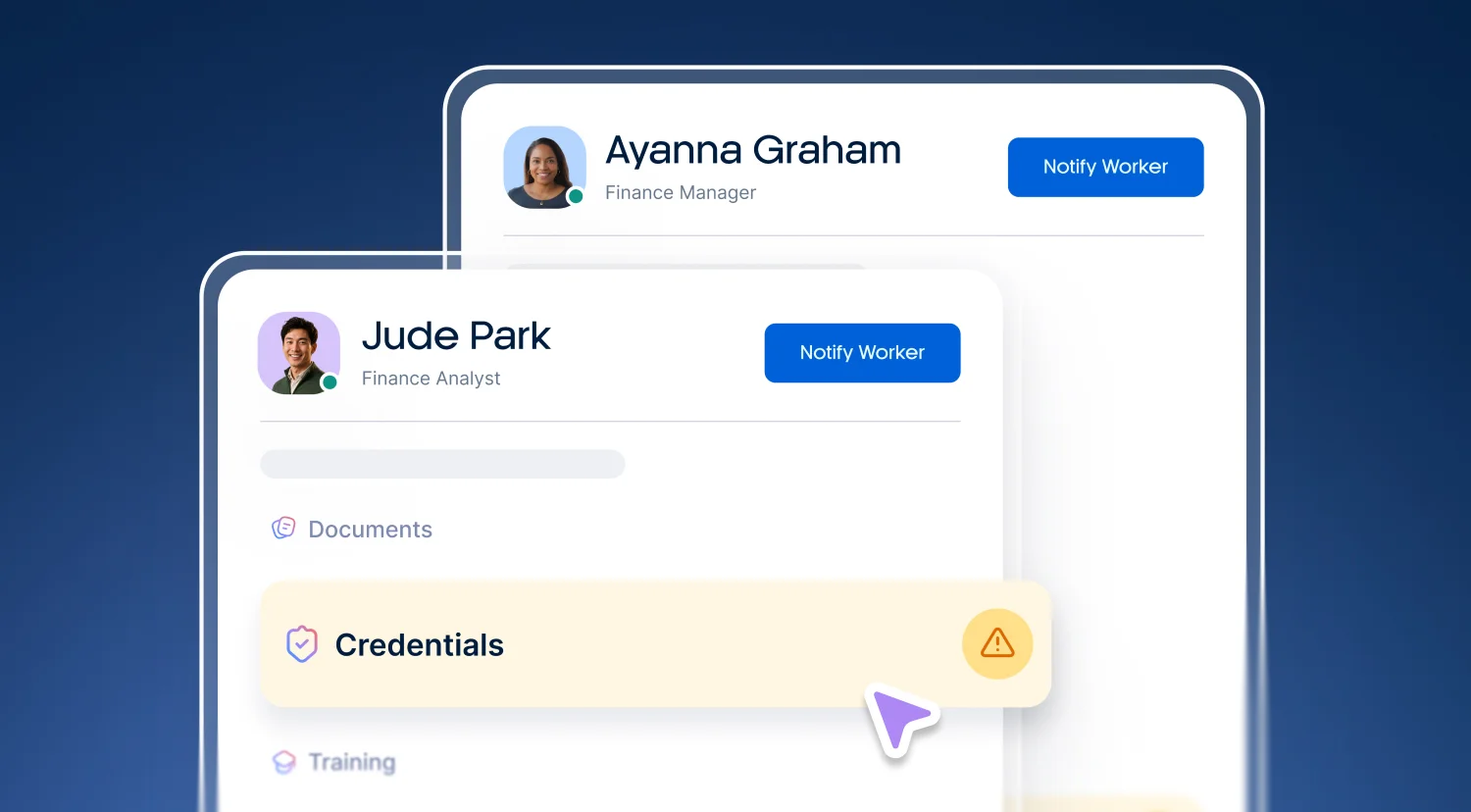
Xemplo integrates compliance requirements into structured onboarding workflows, helping organisations collect the right documents, credentials, checks, and training for each worker and their respective role.
That information is then centralised within the worker profile for ongoing access. Most crucially, however, is what comes afterwards…
Xemplo can send automated alerts and notifications when compliance obligations are approaching expiry or demand action, supporting workers and administrators alike in their efforts to address critical matters before they can become a problem.
Dashboards offer teams a broader view of their workforce, enabling them to identify outstanding requirements without combing through individual files one by one.
That fundamentally changes how compliance can be managed day-to-day. Instead of relying on someone to remember to check everything, you have a more proactive way to hone in on specific workers, requirements, and upcoming expiries.
The question worth asking
The key takeaway is that an organisation can have the most diligent compliance processes and still be maintaining poor visibility across its workforce.
The real test is what happens when someone asks for the current picture.
Can you quickly identify which workers have completed their requirements, which haven't, and which are approaching an expiry – without piecing the answer together from several disconnected sources?
Because compliance isn't “finished” simply when documents are filed. The organisation needs to know what that document means now (and what needs to happen next).
If your team can't readily answer those questions, the problem may not be compliance itself. It may be visibility.


.webp)
.webp)