
For whatever reason, the person principally responsible for the accuracy of their workforce record is rarely the person actually charged with maintaining it.
By virtue of being the very source of their information, employees generally know:
- Their most current address
- Their most current bank account
- When they’ve completed a new qualification
- When their availability suddenly shifts
Yet in countless businesses, workers effectively remain tourists to their own workforce management systems. They simply submit the data points to someone else (usually an HR manager), who needs to be prompted every time the slightest detail changes.
From there, that data travels through a long chain of potential friction points and barriers – administrators, managers, platforms, approvals, checks, etc. – and each step is just another opportunity for delay, duplication, or error.
Nowadays, workforces are bigger, more distributed, more mobile, and more reliant on accurate information than ever before. Despite this, organisations continue to manage employee information using wildly impractical manual processes from a bygone era.
This is where employee self-service represents a fundamental shift within the realm of workforce management.
Not because workers need another interactive portal. Not because there’s some nefarious plot to remove HR from the equation. But because it can improve governance and accuracy, while freeing up HR capacity for higher-value work.
Work on the business instead of in the business, as they say.
Related: Onboarding Should Be A Recruitment Outcome (Not An Afterthought)
The problem hidden in plain sight
The modern employee generates an extraordinary amount of information. Keeping that information consistent, accurate, and useful across the business can quickly take on a life of its own.
Once an employee is onboarded:
- Their details become relevant to payroll
- Their credentials determine whether they can perform certain duties
- Their employment changes influence reporting, compliance, and workforce planning
When employees are functionally divorced from these processes, it creates redundant administrative layers, which may prevent worker records from being accurate from the start.
HR teams chase information rather than governing it. Managers constantly question their supposed “single source of truth.” Payroll teams reconcile and correct upstream errors rather than processing clean pay runs.
The issue isn’t a lack of effort. It’s an operating model that asks individuals to compensate for inadequate processes.
Self-service is about ownership (not delegation)
Employee self-service is sometimes misunderstood as a way for organisations to transfer administrative workload from HR teams to employees.
That assumption misses the point.
The true value of self-service lies in bringing employees closer to the information they generate. Organisations, on the other hand, retain control over the procedures, approvals, and compliance obligations that determine how those data inputs are used.
What you get is stronger governance. Not less governance.
That doesn’t mean every employee update should flow straight into a system unchecked, either. Employees should simply be able to initiate and complete the appropriate action, while the organisation retains control over validation, permissions, and approvals.
By limiting handovers between employees, managers, HR teams, and systems, organisations can simultaneously improve data accuracy and reduce the admin overhead required to maintain it.
The greatest efficiency gains don’t come from eliminating individual tasks. They come from policing how often the same information must be requested, re-entered, and reconciled across disjointed processes.
Why self-service data governance matters for modern workforces
The case for employee self-service becomes increasingly relevant as workforces become more distributed, mobile, and compliance-intensive.
In tightly regulated sectors such as NDIS / disability and community services, healthcare, and security services, employees are often:
- Working across multiple sites and locations
- Managing changing schedules
- Fulfilling ongoing requirements (i.e. qualifications, training, credentials)
In these environments, workforce systems cannot depend on every update flowing back through an administrative chokepoint.
Employee actions must directly contribute to workforce readiness:
- Completed training should improve compliance visibility
- Credential updates should inform operational decision-making
- Employee information changes should maintain workforce record accuracy
This is where self-service moves beyond convenience into workforce management capability.
The key difference is between a platform that allows employees to access information and one that enables them to actively improve operational accuracy.
When self-service is embedded within the wider ecosystem, workers benefit from greater ownership over their employment information; organisations benefit from transparency, control, and confidence in their workforce data.
Related: Performance Management Isn’t Just For When Things Go Wrong
How Xemplo enables connected employee self-service
Xemplo is built around the principle that workforce information should move seamlessly throughout the employee lifecycle without duplication, manual intervention, or fragmented processes.
By consolidating onboarding, ongoing workforce management, compliance, and payroll workflows – and integrating with the recruitment, payroll, and other business modules already in use – Xemplo reduces the number of times workforce information must be captured and maintained.
Essentially, it allows employees to personally curate their workforce records while organisations maintain all necessary controls.
With Xemplo Onboard, employees provide their details, complete role-based onboarding activities, review and sign employment documentation, acknowledge policies, before submitting credentials through structured digital workflows.
HR and managers can even track progress and focus their attention on outstanding requirements or exceptions.
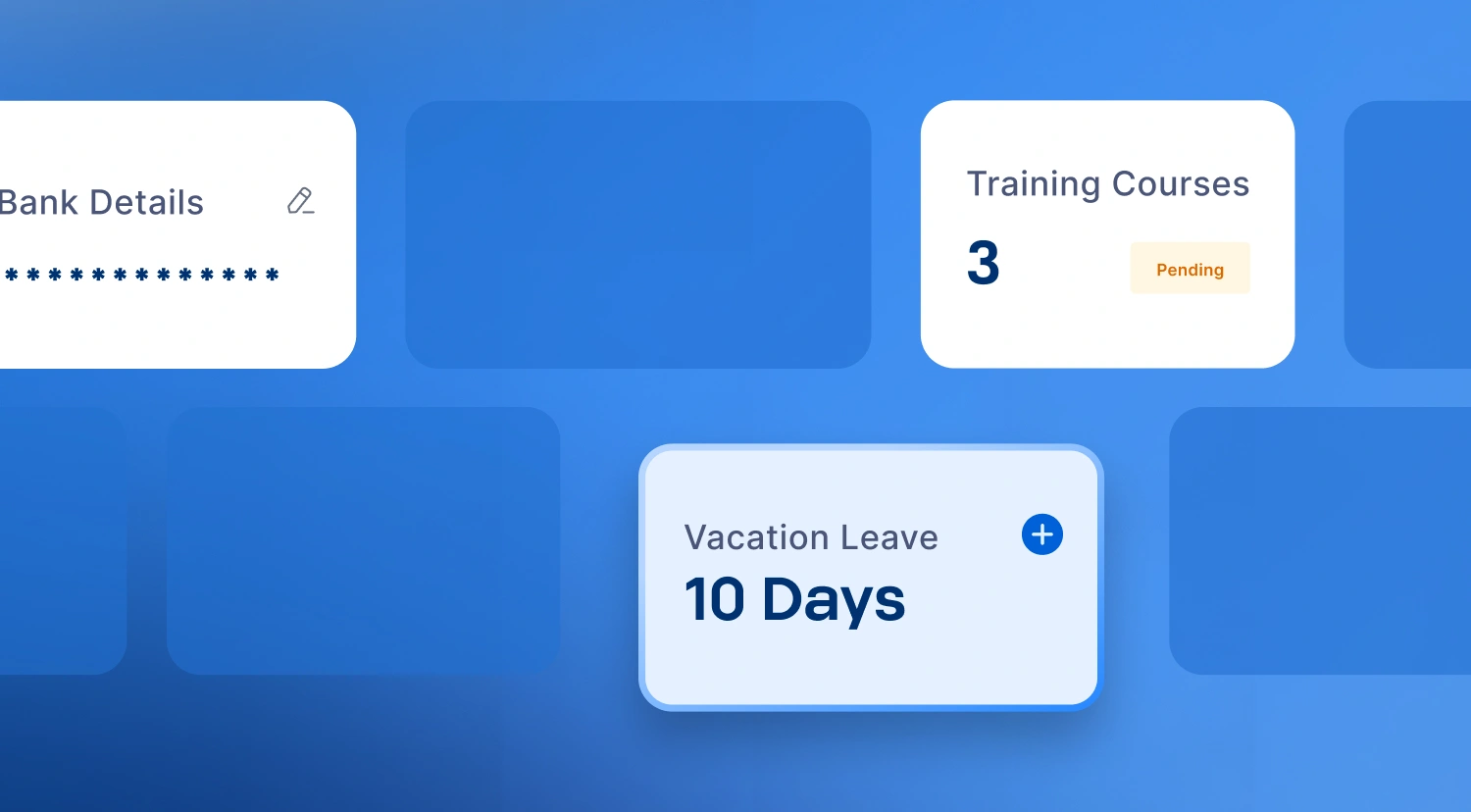
Once an employee officially commences, Xemplo Employ allows them to update personal details when needed, access key documents, finish assigned training, and upload renewed licences, qualifications, or other credentials.
Through Xemplo’s mobile experience, employees and managers can tick off workforce activities wherever work takes place – supporting dispersed teams and faster responses.
For decades, employment information followed a centralised model: employees provided it, organisations managed it, and systems recorded it. The next evolution is a more collaborative model. One where workers have tangible buy-in with data accuracy.
The businesses that embrace this model won’t just cut down on admin. They’ll create a workforce operating model that delivers more accurate information, clearer responsibilities, and decisions made with greater confidence.

_%20A%20Guide%20for%20Australian%20Employers.webp)
.webp)